www.newhamburgindependent.ca/news/article/146465
Shedding light on Haiti's plight
DOUG COXSON, INDEPENDENT STAFF
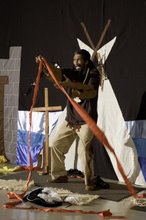
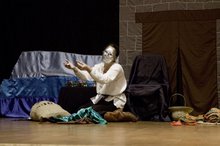
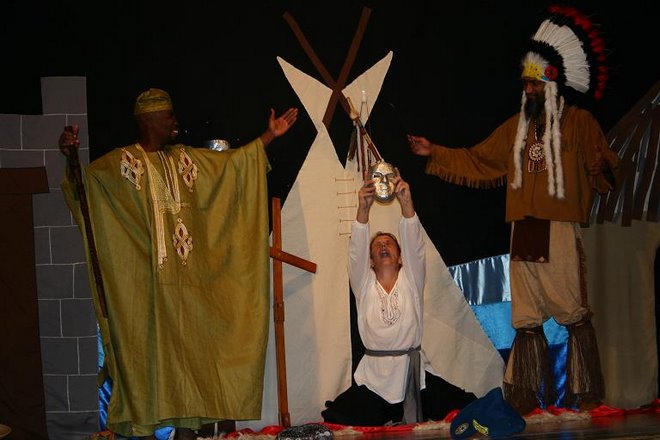
Members of Haiti's N a Sonje Foundation (We Will Remember) and Kore Pwodiksyon Lokal (KPL), or Support Local Production, Genia Eugene, Carla Van Dusen Bluntschli and Harry Nikolas are on the road with Wilmot natives Josh and Marylynn Steckley to enlighten Canadians about the problems facing the Caribbean nation. They will be performing a play entitled 'Three Innocents and a Spirit' at a number of local venues next week.
MCC's Josh and Marylynn Steckley promote local eating message in Haiti
By Doug Coxson
News
Oct 08, 2008
It's been three weeks since Hurricane Ike tore through the Caribbean on a path of destruction.
But unlike the tourist-friendly islands hit hard and in recovery, Haiti is still reeling, battered and bruised from the series of storms that killed close to 500 people and left an estimated 800,000 struggling to find food, shelter and water this summer.
The full enormity of the devastation wreaked on the poor Caribbean nation likely won't be known for months as isolated and cut-off communities continue to make contact and appeals for help.
As policy analysts and advocacy workers for Mennonite Central Committee in Port-au-Prince, Josh and Marylynn Steckley were there to witness the recent storm impact on Haiti's already weakened and beleaguered poor population.
The Wilmot natives have been working in Haiti since January 2007 to help bring about change to the country's detrimental trade policies that have resulted in a steep escalation in food prices and led to a violent backlash.
Recent blows to the country's people and infrastructure have taken their toll on an already bad situation.
The Steckleys' work in Haiti is directed at the root of a problem that contributes to the country's vulnerability during times of crisis.
Working with funds from the Canadian International Development Agency, administered through MCC, the Steckleys have teamed with a group in Haiti to help instigate change in what many feel is the country's core problem -- a lingering, emotional paralysis stemming from Haiti's history of slavery and oppression, and the country's increasing reliance on imported food.
"We were trying to identify points of focus for our work and after reviewing the destructive consequences that neoliberal trade policies have had on Haiti, we decided that an appropriate area of focus would be on food systems and food sovereignty," writes Marylynn. "Our initial ideas were to start something similar to the 'Buy Local' movements that are now so popular in the KW area."
Steckley, who holds a masters in geography from the University of Waterloo, said she and Josh eventually joined a small group of like-minded Haitians to found an organization called Kore Pwodiksyon Lokal (KPL), or Support Local Production.
"KPL is really a movement to encourage people in Haiti to consume what is produced in-country," says Marylynn.
Josh, who graduated from Laurier with a masters in political science, has been filming and editing public service announcements geared to the Haitian middle class, encouraging them to buy locally-produced food. (The PSAs are available to view on YouTube under "Kore Pwodiksyon Lokal"). The commercials have been playing on several Haitian television and radio stations since February.
On the road in Kitchener recently, the group talked about their fall tour through Canada and the US to share their knowledge about the food security situation in Haiti and to demonstrate the need for people in Canada to take action and eat locally here.
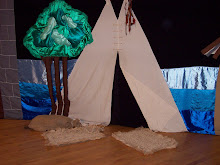
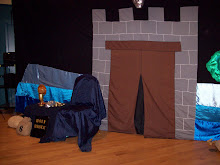
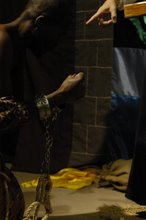
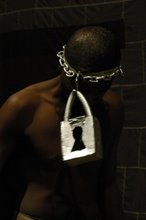
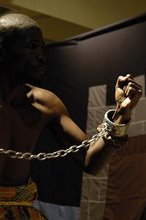
To engage its audience in the history and culture behind Haiti's ongoing struggle, the team members who make up the N a Sonje Foundation (We Will Remember) is also performing a play entitled 'Three Innocents and a Spirit.'
MCC volunteer, KPL founder and N a Sonje performer Carla Van Dusen Bluntschli describes the play as a drama that condenses 700 years of Haiti's history in the context of the country's current dilemma. "The intention is to connect people with particular events that have caused the current imbalance in our society," she says.
Haiti, she adds, is just one of many examples of how European invasion and dominance has had a lasting negative impact on people and cultures throughout Africa, North America, South America and the Caribbean.
Bluntschli, who moved to Haiti from the US in 1985, says the spirit of domination continues here in Canada among First Nations people.
But Haiti's aboriginal people are no longer around to tell their stories.
The Taino people, who inhabited the island before Christopher Columbus claimed it as Spanish territory in the 15th century, were wiped out by disease and other factors related to their poor treatment by the Spanish occupiers.
Group member Harry Nicolas (pronounced Ari) sees parallels in the situation of some of Canada's First Nations peoples, especially after the group's recent visit to Winnipeg.
Oppression, he says, is along the same lines as slavery. "It leaves a person in constant slavery," he says. "Slavery is like a cow they castrate. It almost seems irreversible. That's what someone who suffers slavery looks like. It is passed down from generation to generation and
people confuse it with genetics."
Working to recapture the ancient ancestral African values is part of the difficult task Nicolas and other Haitians face 200 years after slavery was abolished in Haiti.
"You must reeducate yourself so you realize it's slavery that did that. That it's not why you're the way you are."
Nicolas believes encouraging Haitians to change their habits, consume local food and become more self sufficient are the first steps to breaking the bonds of oppression that have stifled progress for centuries.
Media concentration on Haiti's problems over the last decade have shed light on one problem the country faces that would seem to make the suggestion of consuming local food next to impossible. Much of Haiti's once vast forests have been wiped out through rampant deforestation in order to feed the lucrative charcoal trade. That has left much of the country's soil weakened.
But Bluntschli says most of the propaganda touting Haiti's inability to thrive on its own is a perpetuated by governments that benefit from exporting food.
"It appears Haiti can't feed itself but we have so much variety that we could eat and satisfy ourselves completely," adds Nicolas.
Genia Eugene, who hails from Haiti's rural north, says the biggest obstacle to Haiti's self reliance is a lack of infrastructure preventing the transport of produce from the rural areas to the urban markets. "The road conditions are often so bad that they don't allow food to get into the cities," she says. By the time a truckload of fruit makes its way to market, the cost of getting it there makes it too expensive for most people to purchase.
Steckley says during the demonstrations in April, the price of imported rice tripled while the price of local rice only went up 10 per cent.
Foreign countries continue to flood the market with cheaper imports.
Media reports have also depicted Haiti's cities as trash-filled slums. Nicolas says those images reflect blatant neglect by the poorest populations in light of the fact they feel no connection to where they live.
"The peasant farmer working land that is not his own doesn't have any trees on it," explains Nicolas. "But a peasant farmer working land that is his own is full of trees.
People are very aware of their own space.
When you are completely disconnected, disempowered -- you have no orientation to your culture, your country. There's a lot of good that doesn't have value."
Nicolas says what everyone sees in Haiti are the symptoms. Finding solutions to Haiti's core problems and empowering the people through self reliance will bring the country out of its current crisis.
But the recent hurricanes have dealt a shocking blow to the country -- creating a situation Nicolas says will take an enormous amount of international support to help heal.
The financial toll on the country's small agricultural sector is around $180 million. The United Nations estimates basic recovery efforts alone will cost $54 million. So far the country has only received $1 million in contributions.
Nicolas isn't surprised by the lack of action.
"I think that there's a will in the international community to make sure that Haiti never leaves the category of the poorest nation in the world," he says. "That's why there's no real effort to change Haiti's situation -- so the finger can be pointed at Haiti as an example of how things can go wrong."
The group is heading to Ottawa and Montreal this week before returning to the area for a series of local performances and speaking engagements.
On Oct. 18 at 11:30 a.m. the KPL members will present a talk on food security issues in Haiti at the Stanley Park Church, in Kitchener. They will also appear at Empty Bowls Oct. 18. The MCC fundraiser for the reforestation and eating local efforts in Haiti is being held at the Healing Barn north of St. Agatha. (See story on page 17 for details)
On Oct. 19 at 9:30 a.m. the group will present "3 Innocents and a Spirit" at the Shantz Mennonite Church, on Sandhills Road in Baden.
The performances continue on Oct, 20 at 7 p.m. at Living Waters Fellowship, on Hincks Street in New Hamburg.
On Oct. 26 at 10 a.m. the group will present their last local performance of "3 Innocents and a Spirit" at The Gathering, in Kitchener.